No More Manual Mocks: A Case for Learned Cloud Emulators
DevOps engineers face a constant dilemma: testing against the real cloud is expensive and slow, but testing locally requires emulators that often lack features or behave differently than the real thing.
Existing emulators (like the popular LocalStack) rely on manual engineering. We observe that this is a Sisyphean task—AWS alone has over 240 services, and human developers struggle to keep up with the constant stream of new APIs and updates. As a result, coverage is often spotty; for example, we found that an existing emulator LocalStack covers only ~11% of the AWS Network Firewall APIs.
In our paper, we propose a paradigm shift: instead of hand-coding mocks, using Large Language Models (LLMs) to learn the emulation logic directly from cloud documentation.
The "Learned Emulator" Approach
Simply asking an LLM to "write a cloud emulator" results in buggy, hallucinated code. To solve this, we introduce a neuro-symbolic workflow that constrains the AI using formal abstractions. We view each cloud resource not just as code, but as a formal state machine (SM) and the entire cloud as a hierarchical state machine.
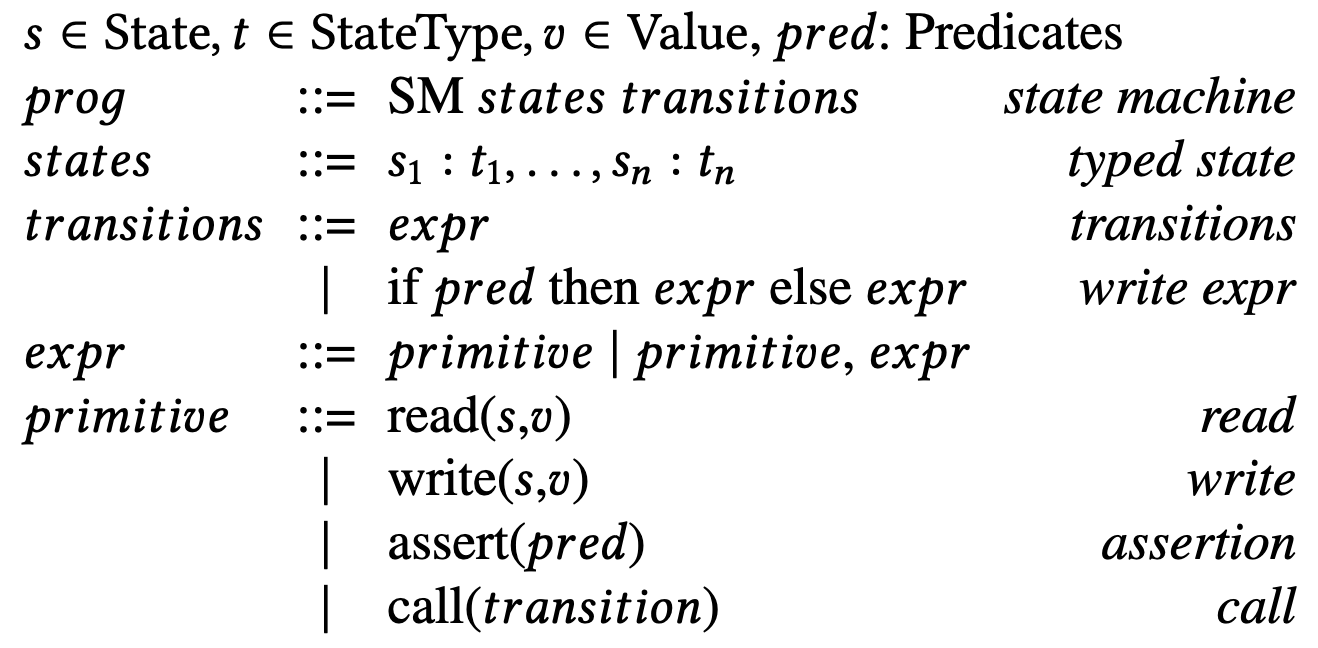
Figure 1: The grammar for specifying an emulator.
Our workflow consists of three key stages:
- Documentation Wrangling: We automatically scrape and index massive cloud documentation (like AWS PDFs), organizing it into resource-specific contexts to overcome LLM context window limits.
- State Machine (SM) Extraction: Instead of generating raw Python code immediately, we task the LLM with extracting a formal State Machine specification from the docs. This captures the resource's states and valid transitions (API calls like
CreateVpc), enforcing logic and dependencies that unstructured code generation misses. - Automated Alignment: To ensure the emulator behaves exactly like the real cloud, we run traces against both our generated emulator and the actual cloud. We detect discrepancies (e.g., an error code mismatch) and feed them back to the LLM to patch the logic automatically.
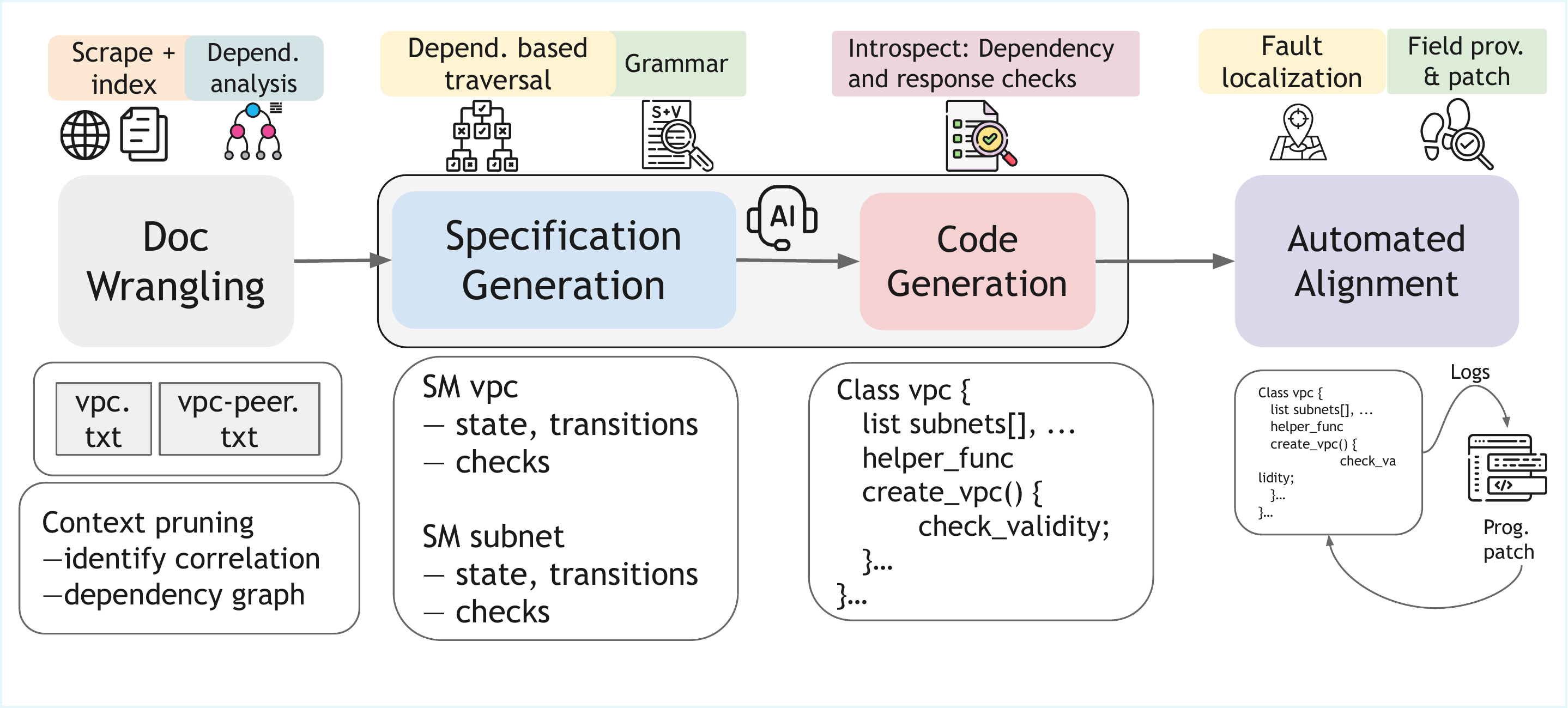
Figure 2: Our envisioned workflow.
Preliminary Results
We built a prototype and the results highlight significant advantages over current manual methods:
- Better Coverage: In our preliminary tests, we achieved complete coverage for the AWS Network Firewall service, compared to just 11% for the state-of-the-art manual emulator.
- Accuracy: By modeling resources as State Machines, we prevent common logic errors. As shown below, our SM-based approach maintains high accuracy during state updates, whereas a direct-to-code (D2C) emulator generation using an LLM often fails completely (0% accuracy) because it loses track of resource dependencies.
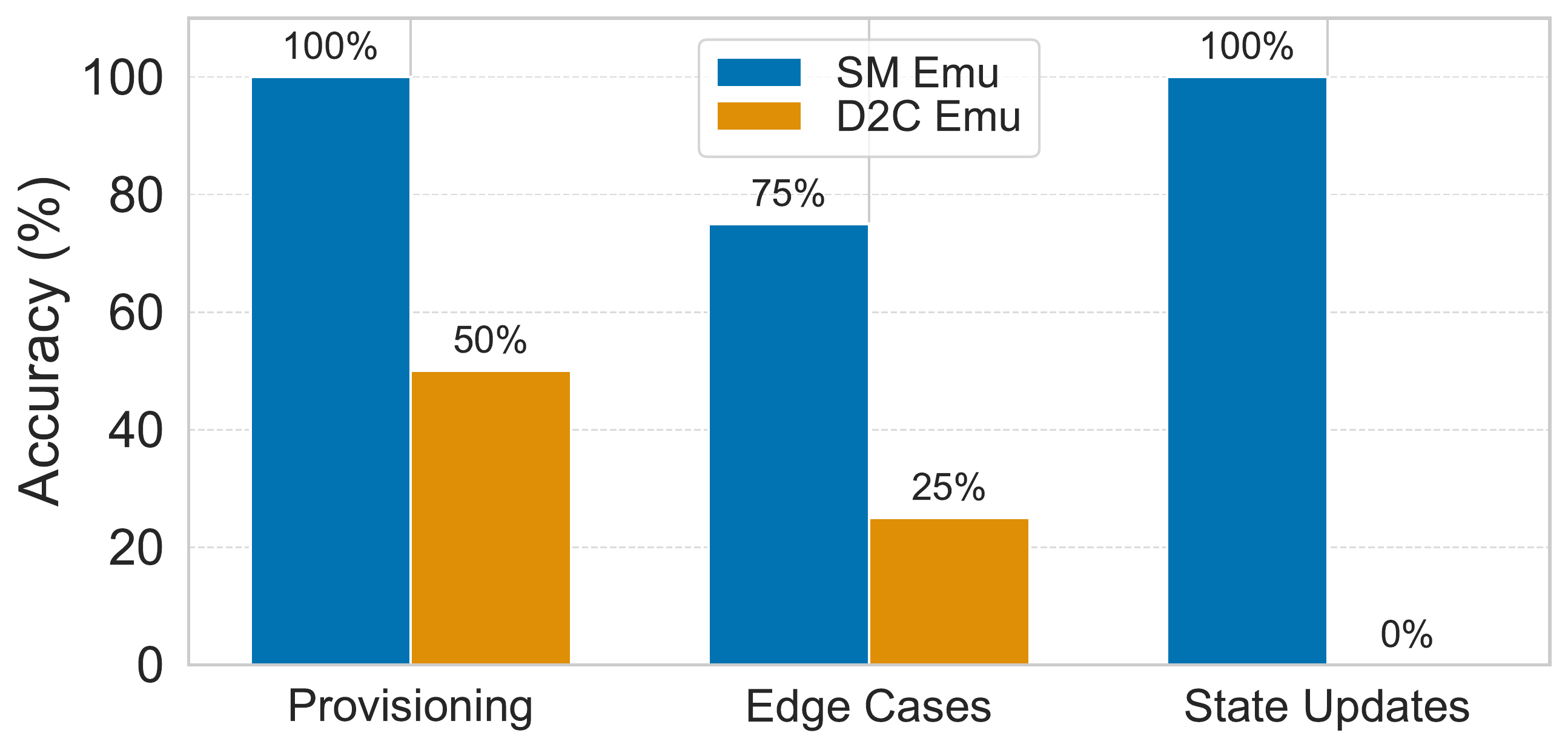
Figure 3: Accuracy of learned emulators across scenarios.
We also used our extracted state machines to quantify the complexity of different cloud services, counting the number of state transitions inherent to services like EC2 versus DynamoDB.
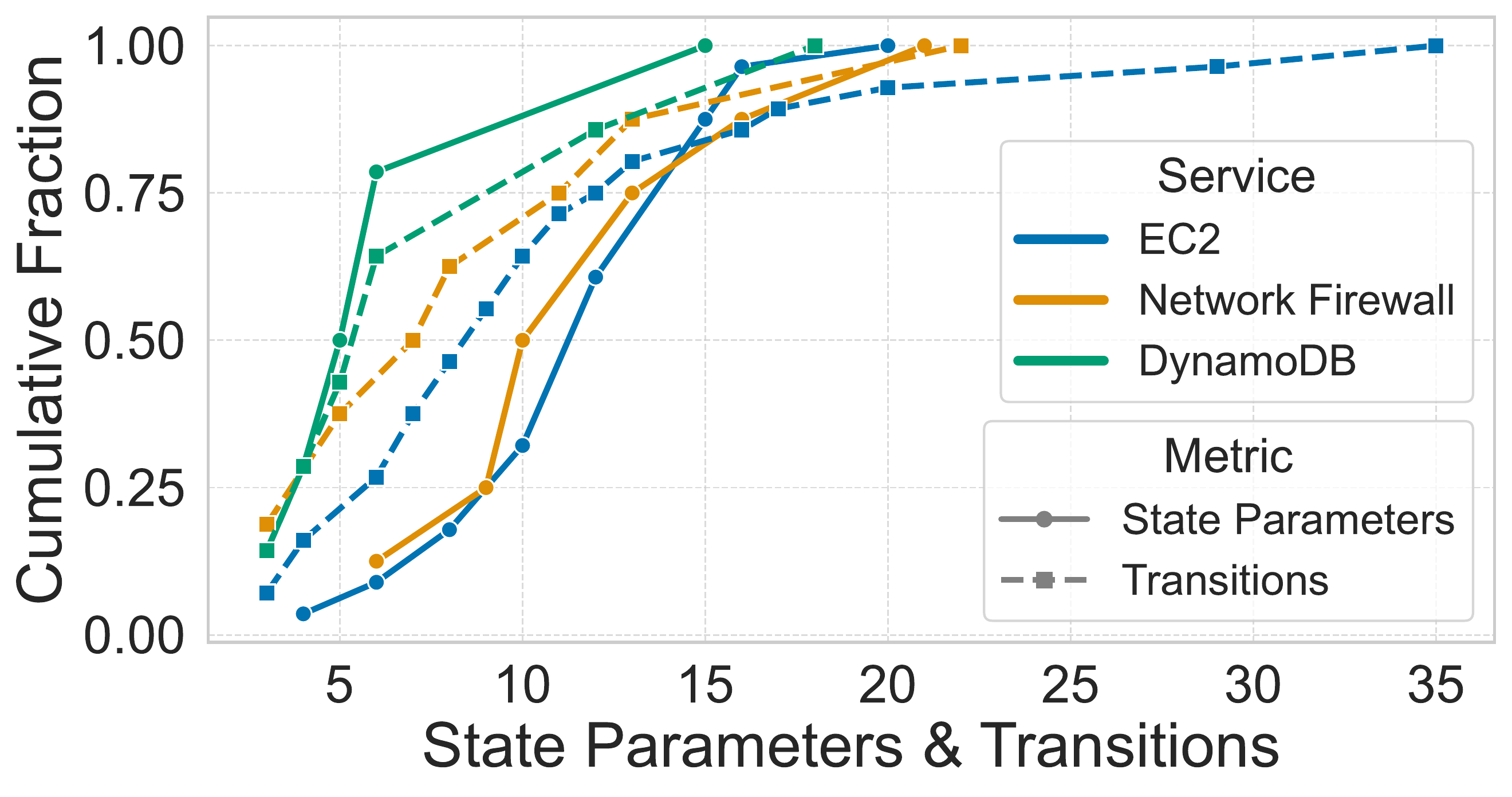
Figure 4: CDF of SM complexity across services.
The Future: A "Cloud Gym"
Beyond just testing, we believe this technology opens new doors. A high-fidelity, zero-cost emulator could serve as a "Cloud Gym", a training ground for AI agents to learn how to manage cloud infrastructure and understand the intricacies, without the risk of racking up a massive bill.
By turning static documentation into executable logic, we hope to finally solve the bottleneck of cloud development velocity.
For more details, check out our full paper in the HotNets '25 proceedings.
@inproceedings{bhatnagar2025cloudemu,
  author = {Bhatnagar, Archit and Qiu, Yiming and McClure, Sarah and Ratnasamy, Sylvia and Chen, Ang},
  title = {A Case for Learned Cloud Emulators},
  booktitle = {Proceedings of the 24th ACM Workshop on Hot Topics in Networks},
  year = {2025}
}